

When autumn transitions into winter across Wake County, most property owners assume that structural pest activity naturally drops off. Common garden ants disappear from view, mosquitoes vanish from backyards, and stinging wasps enter winter dormancy. However, wood-destroying subterranean termites operate under an entirely separate biological lifecycle. Maintaining effective termite control is a vital, year-round necessity throughout the greater Raleigh area because subterranean colonies never stop tunneling, feeding, and expanding.
Central North Carolina’s humid, subtropical climate means that wood-boring insects face very few seasonal roadblocks. Even when winter nights drop below freezing, the topsoil situated directly beneath insulated crawl spaces and concrete slabs retains enough ambient heat for colonies to remain fully active. Our mild regional winters don’t stop termites; the cooling weather simply coaxes them to shift their foraging paths slightly deeper into the soil and closer to your home’s heated foundation headers, where they continue to consume wood cellulose completely undetected.
At Triangle Pest Control, we understand how Raleigh’s unique soil profiles and weather patterns support year-round colony movement. That is why our advanced termite protection framework—offered through our comprehensive SafeHome Premier Plan—is custom-engineered to defend your home through every changing season, utilizing continuous baiting systems and proactive electronic monitoring to deliver durable peace of mind. Safeguarding your single largest financial asset is not a casual, once-a-year task; it is an ongoing process built on a precise understanding of local soil humidity, foundation microclimates, and insect behavior.
Why Termite Control in Raleigh Is a Year-Round Need
The Eastern Subterranean Termite (Reticulitermes flavipes) represents the primary wood-destroying threat to properties across North Carolina. Entomological data compiled by the NC State Extension confirms that these social insects establish massive underground networks, constructing intricate mud transit lines through the topsoil to reach structural wood sources.
Unlike seasonal pests, subterranean workers never sleep, and their structural wood degradation does not pause when winter arrives. Studies from the National Pest Management Association (NPMA) reveal that subterranean termites chew through cellulose twenty-four hours a day, seven days a week. This relentless foraging means that even a minor, localized plumbing leak or direct wood-to-soil contact point can rapidly trigger extensive, hidden structural damage long before a homeowner detects any visual symptoms on the surface.
Because Raleigh’s average winter soil temperatures routinely hover above their critical 50°F ($10^\circ\text{C}$) metabolic foraging threshold, underground workers maintain steady movement through every month of the calendar year. As surface dirt chills, colonies adapt by migrating further down into the earth or moving directly against the warm, insulated infrastructure of your crawl space or basement floor joists.
Raleigh’s Climate Grid Enhances Subterranean Vulnerabilities
Central North Carolina’s regional weather gives foraging termites an extended feeding season with virtually zero natural interruptions:
- Topsoil across the Piedmont rarely experiences a deep, prolonged freeze solid enough to disrupt underground tunneling paths.
- Heavy winter rainfall and lingering humidity collect inside crawl spaces and around masonry foundations, keeping wood soft.
- Indoor residential heating systems continuously radiate warmth downward into the surrounding ground, creating an ideal winter incubator zone.
- While visual reproductive swarms primarily emerge during spring thaws, NC State Extension briefs emphasize that the parent colony remains active beneath the soil all year long.
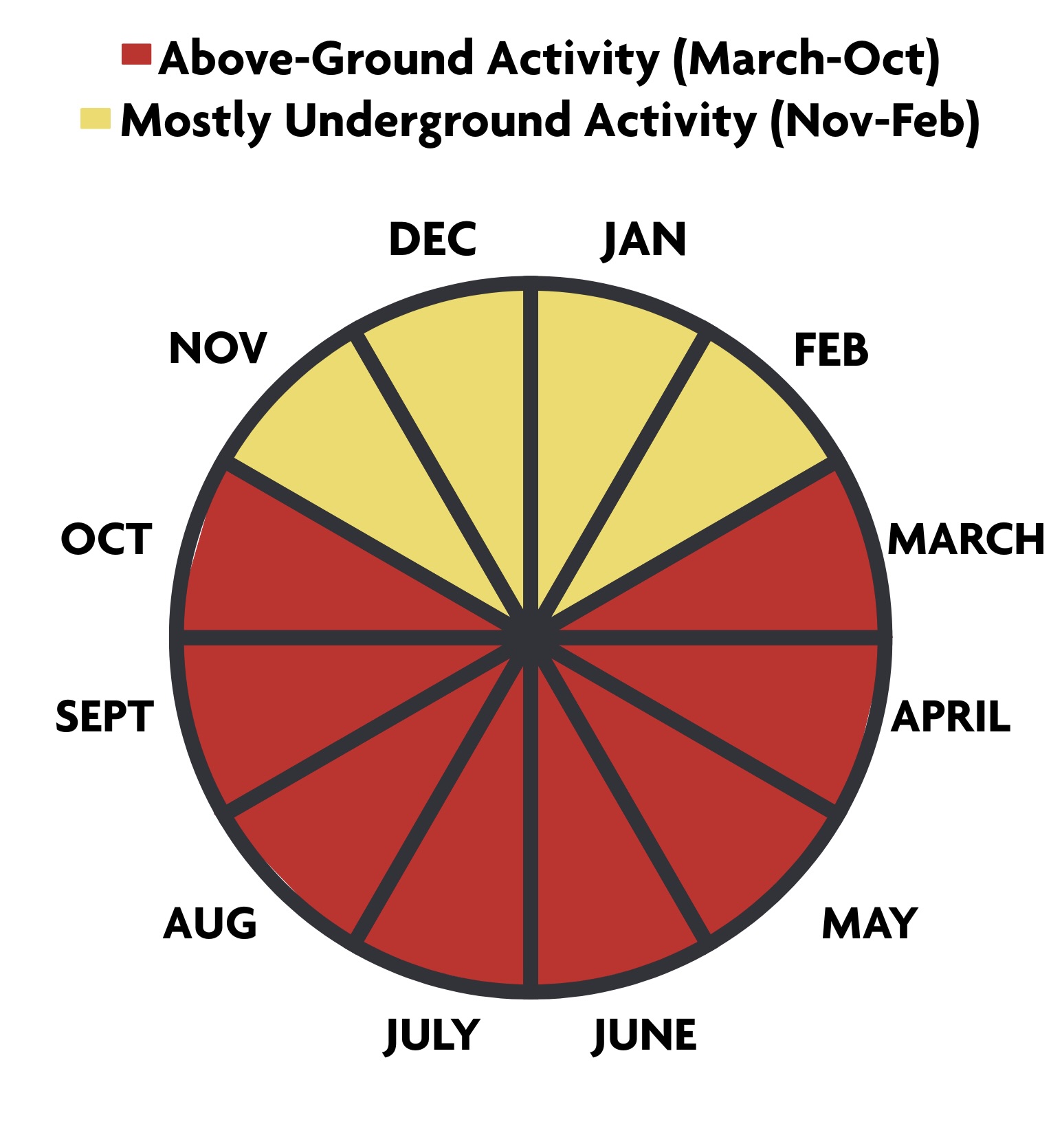
Figure 1. Operational timeline illustrating year-round subterranean termite activity in central North Carolina. While above-ground structural damage peaks from March through October, subterranean foraging and colony growth proceed unhindered throughout the winter months.
Why Winter Is the Most Critical Window for Proactive Protection
Termite colonies are arguably the easiest for homeowners to spot during their high-visibility spring swarming events, but the most deceptive structural degradation unfolds quietly during the winter. Beneath the frost line, central North Carolina’s soil temperatures regularly maintain a stable microclimate, providing workers with the exact warmth they need to continue foraging safely. Unvented crawl spaces stay insulated and humid, delivering a continuous supply of moisture and shelter. This is precisely why winter should never be mistaken for a period of low pest risk; it is the exact window when colonies operate entirely undisturbed and unmonitored by the naked eye.
Crucial Warning Signs Every Wake County Homeowner Must Map
Because subterranean termites tunnel strictly within the internal core of wooden framing, extensive decay can accumulate long before surface paint or veneer shows a blemish. Homeowners should routinely check their foundation lines for these diagnostic indicators:
- Granular mud shelter tubes scaling concrete foundation walls, brick columns, or main plumbing stacks.
- Structural wood framing or baseboards that feel soft, drop in resistance, or yield a dull, hollow ring when tapped.
- Concentrated piles of shed, translucent alate wings left behind on indoor windowsills or near sliding doors following a localized swarm emergence.
- Dark, dimpled, or bubbling sections along drywall sheets that mimic water damage.
- Direct wood-to-soil contact points along wooden decks, porch steps, or storage sheds. The NC State Extension notes that allowing raw timber to touch the ground provides an immediate, zero-resistance bridge for traveling colonies to enter a house.
Customizing Termite Defenses to Match Raleigh’s Soil Profiles
Since native termites maintain an unbroken, year-round schedule, your residential prevention strategy must be equally continuous. The NC State Extension outlines several essential, long-term habits to reduce your baseline property risk:
- Maintain a strict minimum gap of six inches of clear visibility between your topsoil line and your exterior wooden siding.
- Keep organic hardwood mulch beds, stacked firewood piles, and dense landscaping shrubs well away from your foundation concrete.
- Optimize your yard’s grading drainage and repair under-sink faucet leaks quickly to drop ambient crawl space humidity.
- Avoid digging up, disturbing, or adding fresh topsoil over historically treated soil zones directly bordering your foundation walls.
For durable, long-term protection, combining these sanitation steps with a commercial-grade professional baiting framework offers the most reliable defense line. At Triangle Pest Control, we strategically deploy the Trelona® ATBS Advanced Termite Baiting System around high-risk perimeter zones of your property to establish a continuous protective barrier. This advanced technology intercept worker termites as they forage, eliminating existing colonies through non-repellent active transfer while preventing new colonies from moving into the space. Our field experts focus heavy attention on your home’s primary structural vulnerabilities—including utility penetrations, foundation piers, and crawl space accesses—to ensure consistent, year-round population suppression.
Why Certified Professional Management Remains Essential
While maintaining proper yard