
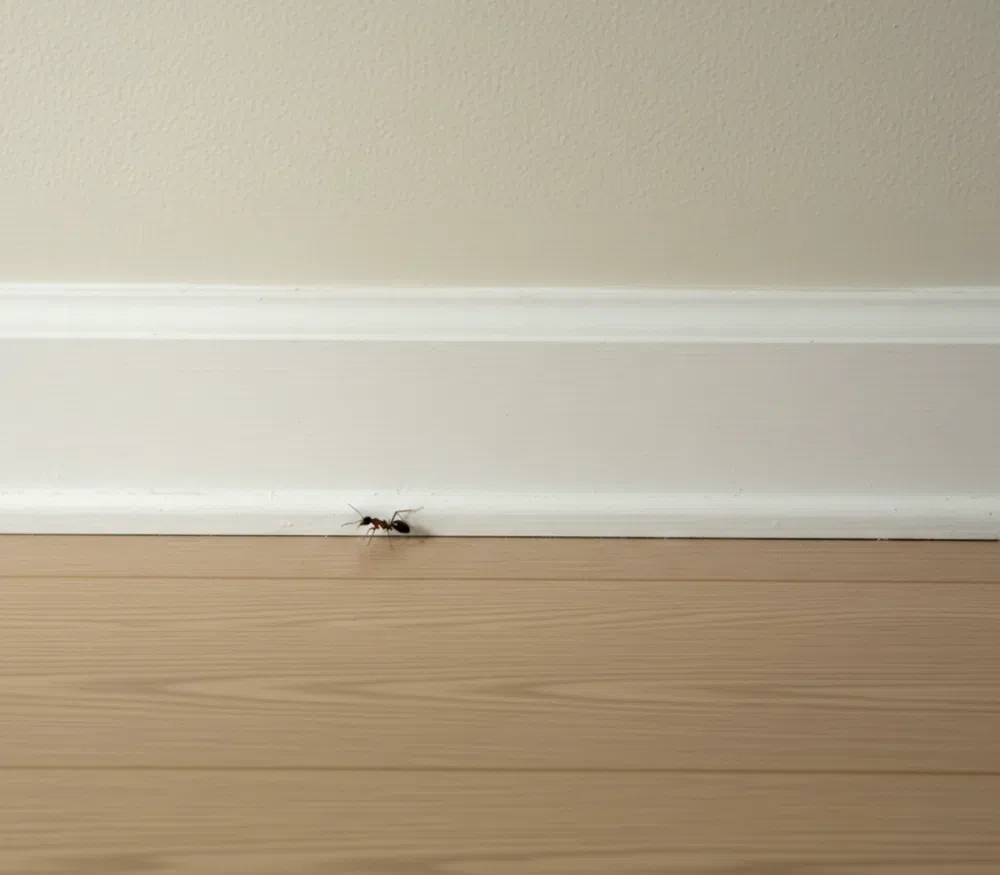
Encountering active insect trails along your baseboards ahead of the official spring season frequently catches local property owners completely off guard. Across the greater Charlotte metro area, fluctuating winter temperatures and unexpected mid-season thaws routinely prompt subterranean ant colonies to wake up and forage much earlier than anticipated. These brief unseasonable warm spells create immediate moisture demands within the nest, driving hungry worker columns to cross unshielded foundation lines in search of easy indoor food rewards weeks before the traditional spring breeding cycle begins.
Partnering with an established pest control company in Charlotte during these early transitions allows you to deploy strategic barriers, intercepting foraging paths before populations swell behind your walls.
Why Ants Become Active Before Spring
Social insect colonies do not follow a digital calendar; instead, their metabolic rates and foraging behaviors respond directly to cumulative soil temperature shifts and basic survival triggers. Research managed by the North Carolina State University Cooperative Extension Service confirms that a broad spectrum of house-invading ant species initiate active interior foraging runs during brief, winter micro-climate tharms as colonies seek vital food and moisture reserves to sustain their queens.
Whenever ambient daytime temperatures consistently cross above the 50°F threshold, topsoil layers surrounding your home’s foundation sills, crawl space vents, and heavy landscaping mulch beds begin to warm. This environmental shift serves as an immediate biological green light, causing dormant workers to launch searching flights into nearby residential structures.
Charlotte Climatic Conditions vs. Early Ant Migration
The specific winter and late-season weather patterns across Mecklenburg County provide direct environmental triggers that drive outdoor colonies onto your property line:
| Southeastern Climate Condition | Biological Colony Response | Structural Impact on the Home |
|---|---|---|
| Daytime temperatures crossing 50°F | Dormant workers resume active metabolic functions | Foraging scouts venture onto low siding plates |
| Warm afternoons paired with cold nights | Outdoor topsoil nests experience rapid thermal drops | Scouts hunt for the stable internal heat of wall voids |
| Heavy winter and early spring rainfall | Subsurface water levels oversaturate underground nests | Colonies migrate upward toward dry floor framing |
| Depleted outdoor honeydew resources | Natural landscape food supplies remain entirely scarce | Workers track indoor kitchen grease and sugar drops |
| Unsealed concrete slab or crawl space cracks | Provides zero resistance to traveling insect columns | Insects breach the living envelope completely unnoticed |
Why Residential Homes Stand Out as Prime Late-Winter Targets
Your home’s infrastructure automatically provides the precise survival elements that outdoor ant colonies lack when regional weather patterns fluctuate. Even a meticulously sanitized home can attract migrating scouts because the structure functions as an environmental oasis, offering:
- Continuous, regulated internal warmth running through sub-floor heating grids.
- Abundant moisture signatures radiating from underlying crawl spaces, bathroom pipe collars, and utility closets.
- Low-resistance physical access channels cutting through unsealed foundation expansion joints and missing weep-hole covers.
Throughout Charlotte residential neighborhoods—including the brick foundations of Ballantyne, the lushly landscaped lots of SouthPark, the historic framing profiles of Dilworth, and the expanding developments across Steele Creek—homes utilizing slab-on-grade foundations or traditional crawl space vents are uniquely vulnerable to early-season insect entry.
Common Pre-Spring Ant Species Infesting Local Properties
Several invasive and native ant species remain structurally active around the Carolinas throughout the year, capitalising on minor warm waves to enter your home:
Odorous House Ants (Tapinoma sessile)
These tiny, dark brown to black insects are notorious for forming high-density, single-file foraging lines tracking along interior baseboards, electrical outlets, and kitchen countertops. When crushed manually, they emit a highly distinct, pungent chemical odor reminiscent of rotten coconuts. They build expansive multi-queen colonies that readily relocate indoors at the first sign of freezing outdoor rains.
Pavement Ants (Tetramorium immigrans)
As their common name implies, pavement ants routinely establish their nesting hubs directly beneath concrete patio slabs, brick driveways, and foundational walkways. Whenever early seasonal temperature swings heat up the stone masonry, these insects tunnel upward through expansion joints, emerging directly inside lower-level utility rooms, garages, and baseboard junctions.
Wood-Boring Carpenter Ants (Camponotus species)
According to entomological data managed by the NC State Extension Service, carpenter ants specialize in excavating nesting galleries inside damp, structurally compromised timber. Discovering these large, dark-bodied ants active inside your living spaces during a brief winter thaw is a major warning sign. While they do not consume wood cellulose for food like termites, their tunneling habits hollow out structural support beams, often signaling an underlying, hidden moisture leak inside your wall voids or crawl space handler line.
Why Early Population Surges Are Frequently Overlooked
An early-season ant introduction rarely begins with an overwhelming, high-volume swarm across your living room floor. Instead, these initial structural breaches present very subtle warning signs that are easy for a busy homeowner to ignore:
- Uncovering a solitary trio of wandering scouts exploring kitchen plumbing fixtures or domestic pet bowls.
- Spotting minor insect activity restricted strictly to sunny, warm afternoon thaws.
- Foraging lines that completely vanish overnight as ambient temperatures drop, creating a false impression that the problem resolved itself.
Dismissing these minor surface sightings is a critical error. While the workers may temporarily retreat to the wall voids when the temperature drops, the primary colony remains established behind the scenes, continuously laying eggs and preparing for an absolute population explosion once spring arrives.
Does Early Activity Predict a Severe Spring Escalation?
Yes. Uncovering active foraging trails ahead of the season confirms that an established parent nest is operating in close proximity to your home’s perimeter. If you allow these early scouts to map out uninterrupted chemical pheromone trails into your pantry food items, you are rolling out a welcome mat for the entire colony matrix. By the time true spring weather settles over Charlotte, the infestation will accelerate rapidly—presenting much heavier tracking trails, developing multiple secondary nesting hubs behind your drywall, and rendering basic do-it-yourself retail sprays completely ineffective.
Proactive Hardening Checklist for Local Homeowners
Property owners can dramatically lower their home’s seasonal vulnerability by executing a few essential maintenance steps during seasonal transitions:
- Seal Foundation Gaps: Apply premium silicone or elastomeric caulk around weathered window headers, exterior door thresholds, and low siding plates.
- Manage Perimeter Topsoil Moisture: Clear out damp leaf blockages from your gutter lines and ensure downspout extensions discharge water far away from your masonry footprint.
- Lock Down Storage Sanitation: Move baking staples, dry pet kibble, and sugary cereals out of cardboard boxes and store them inside airtight glass or heavy-duty plastic storage containers.
- Disrupt Pheromone Tracking Trails: Clean any observed tracking pathways with a simple water-and-vinegar solution to temporarily erase the chemical markers left behind by traveling scouts.
Secure Your Structural Perimeter with Triangle Pest Control
Attempting to manage a developing colony using short-lived consumer bait traps or over-the-counter grocery sprays is a reactive cycle that rarely yields lasting results. Retail chemical sprays are highly repellent, which simply alarms the colony, causing a single nest to fracture (or “bud”) into multiple separate breeding cells deep inside your home’s framing.
At Triangle Pest Control, our QualityPro certified field specialists deploy sophisticated, non-repellent transfer chemistry and targeted bait matrices engineered to match the specific biology of local ant species. Foraging workers collect our specialized treatments and pass them quietly throughout the entire underground network, neutralizing the colony at the true biological source before spring swarms can pick up speed. Protect your home investment from early-season pests—contact our local team today to secure your custom SafeHome preventative barrier shield!